
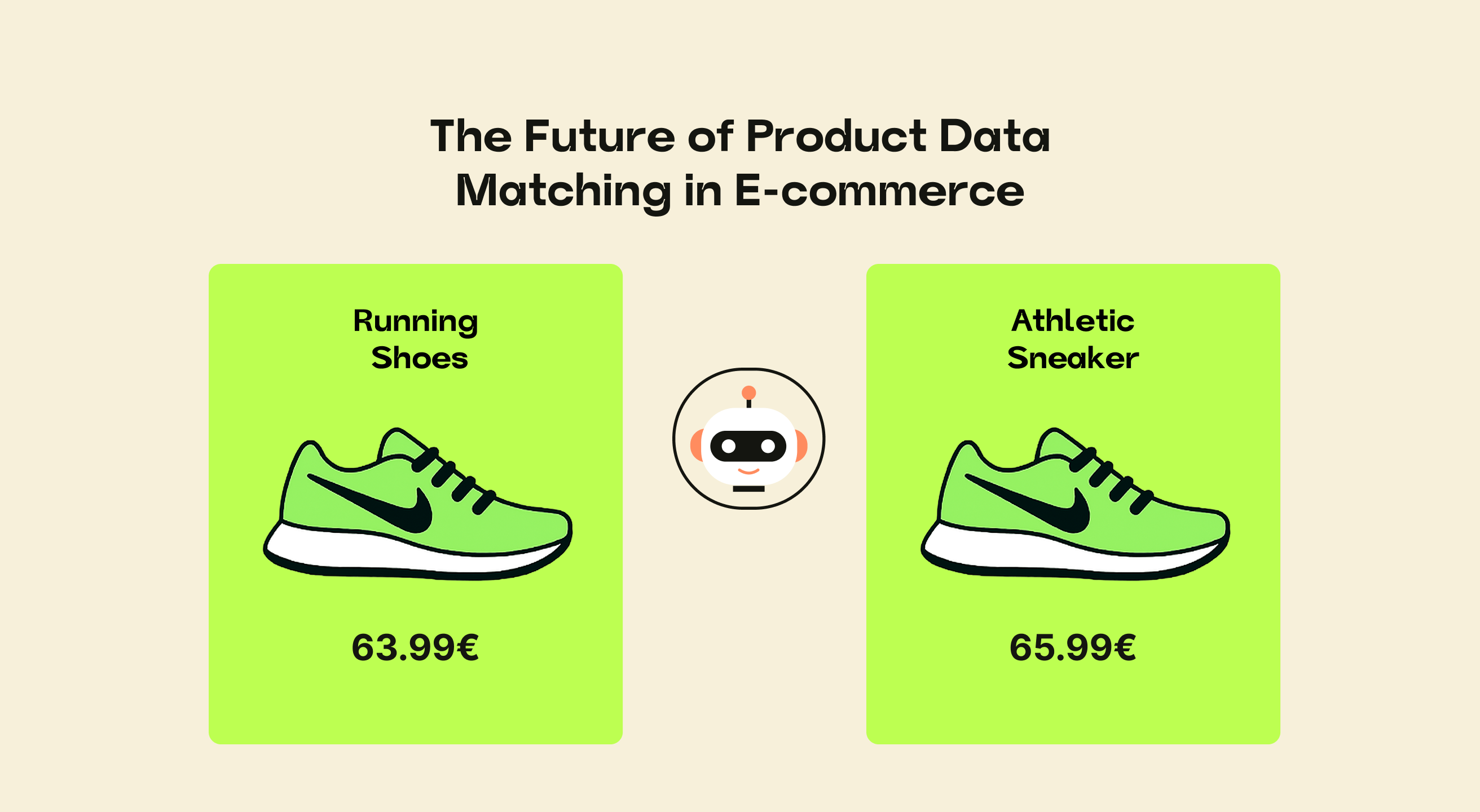
The Future of Product Data Matching in E-commerce: AI-Powered Solutions for 2026
E-commerce businesses face an escalating data quality crisis. With 70% of generative AI models now trained primarily on scraped web data and retailers managing product catalogs across an average of 8.3 sales channels, inconsistent product data has evolved from operational annoyance to strategic liability. A single product appearing as "Blue Sofa XL" on Amazon, "XL Azure Couch" on your website, and "Large Blue Sectional" in your ERP creates cascading problems—from inventory mismatches to pricing errors to customer confusion.
Product data matching—the technology that identifies and links identical products across disparate systems despite naming variations, different SKUs, and inconsistent attributes—has become critical infrastructure for modern e-commerce. According to 2026 AI e-commerce insights, retailers using AI-powered product matching report 10x faster catalog harmonization, 95%+ accuracy on fuzzy matches, and significant improvements in dynamic pricing effectiveness through accurate competitive product identification.
This comprehensive guide explores what product data matching is in 2026, why it matters more than ever, critical warning signs indicating you need better solutions, and how AI transforms matching from manual burden into automated competitive advantage.
What Is Product Data Matching in E-commerce?
Product data matching is the automated process of identifying and linking identical or highly similar products across multiple data sources—supplier catalogs, marketplace listings, internal inventories, competitor websites—even when descriptions, SKUs, images, or attributes differ significantly.
Modern matching systems combine multiple techniques:
Text-Based Matching:
- Tokenization breaking product titles into component words
- Fuzzy string matching handling typos and variations
- NLP semantic analysis understanding "couch" equals "sofa"
- Synonym recognition across languages and regions
Attribute-Based Matching:
- Structured data comparison (dimensions, weight, color, material)
- Hierarchical category alignment
- Brand and model number identification
- UPC/EAN/GTIN standardized identifier matching
Visual Matching:
- Computer vision analyzing product images
- Feature extraction identifying visual signatures
- Similarity scoring for near-identical products
- Multi-angle image comparison handling packaging variations
Machine Learning Matching:
- Training on historical match decisions
- Confidence scoring for each potential match
- Active learning improving accuracy over time
- Pattern recognition detecting systematic naming conventions
According to 2026 e-commerce technology insights, AI-powered matching now achieves 98%+ accuracy on products with complete attribute data and 85-90% accuracy on sparse or messy data—performance levels impossible with manual or rules-based approaches.
Why Product Data Matching Matters More in 2026
The strategic importance of product matching has intensified due to several converging trends:
Omnichannel Proliferation: Modern retailers operate across owned websites, marketplaces (Amazon, eBay, Walmart), social commerce (Instagram, TikTok), comparison shopping engines, and retail media networks. Each platform uses different product identifiers and data structures. Without accurate matching, you can't:
- Maintain consistent pricing across channels
- Track total inventory availability
- Measure true sales velocity
- Optimize marketing spend by product
- Understand competitive positioning
AI-Driven Pricing and Personalization: Dynamic pricing engines require knowing which competitor products match yours. Recommendation systems need accurate product relationships. Personalization algorithms depend on unified customer purchase histories. All these AI capabilities fail without proper product matching as their foundation.
Data Quality as Competitive Moat: According to 2026 competitive intelligence analysis, businesses with clean, matched product data gain significant advantages in AI model training, market analysis speed, and operational efficiency. Your competitors with better matching infrastructure move faster and make better decisions.
Regulatory Compliance: Product safety tracking, recall management, and supply chain transparency regulations require knowing with certainty which products are affected. Matching errors create compliance risk and potential liability.
Customer Experience Expectations: Shoppers expect consistent product information regardless of where they encounter it. Duplicate listings, conflicting prices, and inconsistent descriptions erode trust and drive customers to competitors.
5 Critical Signs Your E-commerce Operation Needs Better Product Matching
Poor product data matching manifests in specific, measurable problems. Recognize these warning signs:
1. Duplicate Listings Plague Search Results and Category Pages
The Problem: Customers searching for "wireless headphones" see the same product listed 3-5 times with slight title variations, different sellers, and inconsistent pricing. This creates several cascading issues:
- Confused customers uncertain which listing is "real"
- Internal competition between your own duplicate listings
- Degraded search relevance and conversion rates
- SEO penalties for duplicate content
- Wasted advertising spend bidding on competing listings
The Data: Marketplaces report that duplicate listings reduce conversion by 15-25% compared to consolidated listings, and each additional duplicate increases customer support tickets by 8%.
The Solution: AI-powered matching identifies duplicates across title variations, consolidates them under canonical listings, and surfaces only the most competitive offer to customers while maintaining seller competition in the background.
2. SKU Conflicts Create Inventory and Fulfillment Chaos
The Problem: Your ERP knows a product as "SKU-12345", Amazon calls it "ASIN B08XYZ", your supplier uses "MFG-ABC-789", and your warehouse has it labeled "BIN-LOC-456". Without SKU mapping:
- Inventory counts don't reconcile across systems
- Fulfillment centers ship wrong products
- Stockout alerts fail because systems don't recognize available inventory
- Purchasing orders duplicate or miss replenishment needs
- Financial reporting can't accurately track product profitability
The Data: Multi-channel retailers report that SKU mismatches cause 12-18% of fulfillment errors and cost an average of $25 per incident in customer service, reshipping, and customer dissatisfaction.
The Solution: Automated SKU mapping creates master product records linking all system-specific identifiers, enabling unified inventory visibility and accurate fulfillment regardless of which system triggered the order.
3. Inconsistent Product Information Damages Brand and Conversion
The Problem: The same product shows different prices on different channels (violating MAP policies or confusing customers), contradictory specifications (weight, dimensions, features), mismatched images (different angles, quality, or even wrong products), and conflicting availability status.
The Data: According to 2026 e-commerce research, product information inconsistency increases returns by 22%, lowers review ratings by 0.4 stars on average, and causes 31% of customers to abandon purchases over uncertainty.
The Solution: Product matching enables centralized product information management (PIM) where updates propagate automatically to all channels, ensuring consistency while allowing channel-specific optimization.
4. High Return Rates Signal Product Expectation Mismatches
The Problem: Customers receive products different from what they expected based on listing information. This happens when:
- Image matching failures show similar but incorrect products
- Attribute variations aren't distinguished (colors, sizes, models)
- Bundled vs. individual products get conflated
- Region-specific versions (voltage, packaging, language) get mixed
The Data: Industry benchmarks show that product information accuracy issues contribute to 35-40% of e-commerce returns. At typical return processing costs of $10-30 per item, this represents significant operational expense.
The Solution: Precise matching distinguishes product variations while identifying true duplicates, reducing returns caused by expectation mismatches and improving customer satisfaction.
5. Manual Matching Bottlenecks Block Scaling and Agility
The Problem: Product catalog teams spend 15-25 hours weekly manually:
- Reviewing potential duplicate flagged by basic rules
- Matching new supplier products to existing catalog
- Harmonizing data after marketplace imports
- Resolving SKU conflicts across systems
- Cleaning up merger/acquisition product integration
The Data: For a retailer with 50,000 SKUs adding 500 new products monthly, manual matching consumes 1,200-2,000 labor hours annually at costs of $75,000-150,000 in fully loaded salaries—plus the opportunity cost of slow catalog expansion limiting revenue growth.
The Solution: AI matching reduces manual review volume by 90%, handling straightforward matches automatically and flagging only ambiguous cases requiring human judgment. Teams shift from data janitor work to strategic catalog optimization.
How AI Revolutionizes Product Data Matching
The transformation from rules-based to AI-powered matching represents a fundamental capability leap. Here's how modern systems work:
Natural Language Processing for Text Matching
Technology: Transformer models (BERT, GPT variants) trained on product data understand semantic relationships between words and phrases. Unlike simple keyword matching, NLP systems comprehend that:
- "smartphone" = "mobile phone" = "cell phone"
- "64GB" and "64 Gigabyte" represent identical storage
- "midnight blue" ≈ "navy" ≈ "dark blue"
- "XL" in clothing ≠ "XL" in furniture dimensions
Advanced Capabilities:
- Multi-language matching without translation
- Brand name variation handling ("Nike" vs. "NIKE®" vs. "Nike Inc.")
- Abbreviated vs. expanded product names
- Marketing language filtering (focusing on attributes, ignoring promotional text)
Performance: According to machine learning e-commerce applications research, 2026 NLP matching achieves 92-96% accuracy on title-only matching, improving to 98%+ when combined with other signals.
Computer Vision for Image-Based Matching
Technology: Convolutional neural networks extract visual features from product images, creating "fingerprints" that identify products regardless of:
- Different camera angles and lighting
- Packaging variations (retail box vs. bulk packaging)
- Background differences (studio shot vs. in-situ)
- Image quality variations across sources
Advanced Capabilities:
- Multi-image matching when products have multiple photos
- Partial product matching (identifying products in lifestyle scenes)
- Counterfeit detection through subtle visual differences
- Packaging change detection for version tracking
Performance: Visual matching achieves 88-94% accuracy as primary signal, serving as powerful confirmation when combined with text matching for 99%+ combined accuracy.
Structured Attribute Matching
Technology: Machine learning models learn importance weighting for different attributes:
- Critical matches: UPC/EAN (near 100% signal when present), brand + model number
- Strong matches: Exact dimension matches, identical weights
- Moderate matches: Color names (accounting for variations), general category alignment
- Weak matches: Generic keywords, marketing descriptions
Advanced Capabilities:
- Unit conversion (pounds to kilograms, inches to centimeters)
- Tolerance-based matching (dimensions within 5% considered matches)
- Hierarchical category mapping across taxonomies
- Missing data inference from other attributes
Performance: When structured attributes are complete, matching accuracy exceeds 99%. Performance degrades gracefully with sparse data, maintaining 80-85% accuracy with minimal attributes.
Ensemble Methods and Confidence Scoring
Technology: Modern systems combine multiple matching signals, weighting them based on data quality and historical performance:
- High-confidence matches (95%+): Automatic approval
- Medium-confidence (75-95%): Fast human review queue
- Low-confidence (<75%): Detailed manual review or rejection
Advanced Capabilities:
- Active learning from human review decisions
- A/B testing different matching algorithms
- Context-aware weighting (visual matching weighted higher for fashion, attribute matching for electronics)
- Explainable AI showing which signals drove match decisions
Performance: Ensemble approaches achieve 96-99% overall accuracy while routing only 5-10% of matches for human review—dramatically reducing manual workload while maintaining quality.
Real-World Implementation Examples
Large Marketplace:
- Challenge: 15 million products, 200,000 sellers, 12 languages
- Solution: Multi-stage matching pipeline with NLP for initial grouping, vision for confirmation, attribute scoring for final decision
- Results: 94% automatic matching, 200x faster than manual, enabled dynamic pricing across consolidated product pages
Multi-Channel Retailer:
- Challenge: Own website + 6 marketplaces + 3,000 SKUs + 15 suppliers
- Solution: Master product record system with AI-powered SKU mapping and automated channel syndication
- Results: Inventory accuracy improved from 78% to 97%, stockout reduced by 32%, eliminated duplicate SKU ordering
B2B Distributor:
- Challenge: Matching 50,000 supplier products across 5 different catalogs with inconsistent data
- Solution: Hybrid AI + human review with continuous learning
- Results: Catalog integration time reduced from 6 weeks to 3 days, 91% automatic matching accuracy
Building a Product Matching Strategy for Your Business
Implementing effective product matching requires strategic approach beyond just selecting tools:
Assessment Phase
Quantify Current State:
- Measure duplicate listing percentage in your catalog
- Calculate time spent on manual matching activities
- Assess SKU conflict frequency and impact
- Survey customer feedback mentioning confusion or inconsistency
- Benchmark return rates against industry averages
Identify Pain Points: Prioritize by business impact:
- Revenue loss from conversion rate suppression
- Operational costs from fulfillment errors
- Brand damage from inconsistent information
- Scaling limitations from manual bottlenecks
- Competitive disadvantage from slow time-to-market
Technology Selection
Evaluate Matching Capabilities:
- Accuracy metrics on representative sample data
- Performance on sparse or messy data (common in real operations)
- Multi-language and multi-region support if relevant
- Image matching capabilities if visual products
- Scalability to your current and projected catalog size
Consider Integration Requirements:
- Compatibility with existing PIM, ERP, e-commerce platforms
- API availability for programmatic access
- Real-time vs. batch processing support
- Export formats and downstream system feeding
Assess Operational Fit:
- Learning curve and team training requirements
- Manual review workflow for ambiguous matches
- Maintenance and ongoing data quality processes
- Vendor support and implementation assistance
Implementation Approach
Start with High-Impact Pilot:
- Choose category with known duplicate issues
- Run parallel matching (AI + manual) to validate
- Measure improvement in specific KPIs
- Refine configuration based on results
Scale Incrementally:
- Expand to additional categories progressively
- Build confidence scoring thresholds based on accuracy data
- Automate high-confidence matches, route others to review
- Continuously improve through active learning
Integrate Across Systems:
- Connect matching output to PIM for centralized data management
- Feed competitive pricing tools with accurate competitor matches
- Enable dynamic pricing with reliable product mapping
- Power analytics with unified product hierarchies
Ongoing Optimization
Monitor Quality Metrics:
- False positive rate (incorrect matches accepted)
- False negative rate (missed matches requiring manual catch-up)
- Review queue size and team handling capacity
- Time savings vs. baseline manual process
Continuous Improvement:
- Regular review of rejected matches for pattern identification
- Periodic retraining on updated data and feedback
- A/B testing matching algorithm variants
- Category-specific tuning for specialized products
The Future: What's Next in Product Matching Technology
Looking ahead, several trends will shape product matching evolution:
Multimodal AI Integration: Systems combining text, images, structured data, and even video/AR content for richer matching signals. According to e-commerce AI automation insights, products demonstrated in video content can be matched across catalogs automatically.
Real-Time Competitive Matching: As web scraping becomes more sophisticated (98.4% accuracy with AI methods), competitive product matching happens in real-time, enabling instant price positioning adjustments and stock-out capitalization.
Supply Chain Integration: Matching extending backward to raw materials and forward to customer usage patterns, enabling end-to-end product lifecycle tracking and circular economy enablement.
Sustainability Tracking: Product matching enabling accurate carbon footprint calculation, ethical sourcing verification, and regulatory compliance across entire product lifecycles as ESG requirements intensify.
Decentralized Product Graphs: Blockchain-based shared product databases where manufacturers, retailers, and marketplaces contribute to unified, authoritative product records with cryptographic verification.
Conclusion: Product Matching as Strategic Infrastructure
Product data matching has evolved from technical housekeeping task to strategic capability determining competitive position. In 2026's omnichannel environment where retailers operate across 8+ platforms, AI models depend on training data quality, and customers expect consistency everywhere, businesses with superior matching infrastructure gain compounding advantages.
The evidence is clear: AI-powered matching delivers 10x speed improvements, 95%+ accuracy on fuzzy matches, and 90% reduction in manual review workload. These aren't marginal optimizations—they're fundamental capabilities enabling dynamic pricing, accurate inventory, consistent customer experience, and scalable operations.
But tools alone don't deliver results. Success requires:
- Strategic assessment quantifying current impact and prioritizing pain points
- Appropriate technology matching your data characteristics, scale, and integration needs
- Phased implementation proving value incrementally while building organizational capability
- Continuous optimization monitoring quality and refining through active learning
For teams serious about competitive e-commerce in 2026, platforms like ScrapeWise.ai provide automated product matching as part of competitive intelligence infrastructure—identifying competitor products accurately despite naming variations and enabling dynamic pricing based on true competitive positioning.
The transformation from manual matching to AI-powered automation represents more than efficiency gain. It's about building data quality as sustainable competitive advantage—enabling faster market response, more accurate decisions, and superior customer experiences. Organizations embracing this transformation position themselves to thrive as e-commerce complexity intensifies. Those treating matching as afterthought risk falling behind competitors who move at the speed of clean, matched data.