
Competitive Price Monitoring Tools: Complete 2026 Buyer's Guide
The price monitoring software market is experiencing explosive growth, projected to reach $5.09 billion by 2033 at 13% CAGR, as retailers recognize that competitive pricing intelligence has shifted from optional to essential. In 2026, with 90% of online shoppers actively comparing deals before purchase and 60% citing price as the key purchasing factor, businesses without automated competitor price tracking operate at a fundamental disadvantage.
Modern price monitoring has evolved far beyond manual spreadsheet updates. Leading platforms now combine AI-powered pricing optimization, real-time competitor tracking across thousands of sources, and dynamic repricing that protects margins while maintaining market competitiveness. According to industry data, retailers using automated price monitoring report 3-20% profit margin improvements and 30% time savings on competitive analysis.
This comprehensive guide explores the best competitive price monitoring tools in 2026, strategic implementation for B2B versus B2C operations, MAP compliance automation, and how to build a complete competitive intelligence stack that delivers measurable ROI.
What Is Competitive Price Monitoring?
Competitive price monitoring is the automated tracking and analysis of competitor product prices across websites, marketplaces, and sales channels to inform pricing strategy and maintain market competitiveness. Unlike manual price checking that captures snapshots in time, modern monitoring systems continuously scrape competitor data—often multiple times daily or in real-time—to detect price changes, promotional activity, and market positioning shifts as they occur.
The technology combines web scraping infrastructure, product matching algorithms, and business intelligence dashboards to transform raw competitor pricing data into actionable strategic insights. According to 2026 market analysis, leading price monitoring platforms now integrate AI algorithms and machine learning for dynamic pricing, real-time optimization based on competitor behavior, demand patterns, and market trends.
How Price Monitoring Works in 2026
Modern systems operate through several integrated components:
Data Collection:
- Web scraping extracts pricing from competitor websites, marketplaces, and comparison shopping engines
- API integrations pull data from platforms providing structured feeds
- Manual uploads capture B2B catalog prices from PDFs or password-protected portals
- Multi-channel tracking monitors the same products across different sales platforms
Product Matching:
- AI-powered algorithms identify identical products even when competitors use different names, SKUs, or descriptions
- Image recognition technology matches products visually when text-based matching fails
- Manual validation options handle edge cases and specialty products
Analysis and Intelligence:
- Real-time dashboards visualize pricing position relative to market averages and specific competitors
- Historical trend tracking shows pricing patterns over time (seasonal variations, promotional cycles)
- Automated alerts notify teams when competitors change prices beyond defined thresholds
- Competitive positioning analytics show where you rank (lowest price, middle of pack, premium)
Action and Automation:
- Dynamic repricing engines automatically adjust your prices based on business rules
- Integration with e-commerce platforms, ERPs, and pricing tools enables immediate execution
- A/B testing capabilities measure price change impacts on conversion and margin
Best Competitive Price Monitoring Tools for 2026
The competitive landscape has matured significantly, with platforms now specializing by company size, industry vertical, and strategic focus. Here's an objective comparison based on 2026 market analysis and user reviews.
Enterprise-Grade Solutions
Omnia Retail
- Best for: Mid-to-large retailers requiring enterprise accuracy and scalability
- Key strengths: G2 Winter 2026 Leader in Retail Pricing Software for both customer satisfaction and market presence, flexible refresh rates with no preset schedules, enterprise-grade data validation
- Unique features: Omnia Agent uses agentic AI to spot pricing shifts and surface what matters without manual reports, direct API connections with major comparison shopping engines
- Use case: Multi-channel retailers monitoring marketplace competition, Buy Box dynamics, and unauthorized sellers
- Pricing: Custom enterprise quotes based on SKU count and features
Wiser (formerly Retail Solutions)
- Best for: Unified solution combining pricing intelligence and market analytics
- Key strengths: Comprehensive platform integrating competitor tracking, promotional monitoring, and inventory intelligence
- Unique features: Combines pricing data with marketing performance analytics for holistic strategy
- Use case: Retailers wanting single platform for all competitive intelligence needs
- Pricing: Enterprise-level with custom quotes
Competera
- Best for: AI-powered predictive pricing intelligence
- Key strengths: Machine learning algorithms predict competitor moves and demand patterns
- Unique features: Prescriptive pricing recommendations based on elasticity modeling
- Use case: Retailers with data science capabilities seeking advanced optimization
- Pricing: Custom enterprise pricing
Mid-Market Platforms
ScrapeWise.ai
- Best for: Automated product matching and regional pricing insights for e-commerce
- Key strengths: Purpose-built for competitive intelligence with built-in compliance, proxy management, and structured data delivery
- Unique features: Focus on e-commerce and wholesale competitive monitoring with fast setup
- Use case: Mid-market retailers needing reliable competitor price data without infrastructure complexity
- Pricing: Subscription-based with transparent pricing tiers
Prisync
- Best for: Small to medium businesses wanting fast deployment and actionable insights
- Key strengths: Simple yet powerful interface, strong Shopify and e-commerce platform integrations, 3-20% margin improvement reported by users
- Unique features: Self-service setup with URL-based or channel-based monitoring options
- Use case: SMB retailers with up to several thousand SKUs needing quick implementation
- Pricing: Transparent pricing starting at entry level, free 14-day trial
Price2Spy
- Best for: MAP monitoring and global multi-marketplace tracking
- Key strengths: Excellent product matching accuracy, detailed price history, strong integration capabilities
- Unique features: Robust MAP compliance features with violation detection and evidence collection
- Use case: Brands selling through reseller networks needing MAP enforcement
- Pricing: Tiered plans based on product count
Minderest
- Best for: European retailers and brands operating across 40+ countries
- Key strengths: 10+ years experience as price intelligence pioneer, unlimited geographic and currency coverage
- Unique features: Strong catalog intelligence alongside price monitoring
- Use case: International retailers needing multi-country price tracking
- Pricing: Custom quotes based on scope
Specialized Solutions
Skuuudle
- Best for: B2B catalog tracking and distributor price monitoring
- Key strengths: Handles PDF catalogs and password-protected B2B portals
- Unique features: Built specifically for B2B pricing cycles and wholesale operations
- Use case: Wholesale distributors and B2B suppliers tracking competitor catalogs
- Pricing: Custom B2B-focused pricing
Visualping
- Best for: Simple change monitoring with visual diff capabilities
- Key strengths: G2 Winter 2026 #1 ranking in Website Change Monitoring, screenshot evidence, 30-second monitoring frequency
- Unique features: AI filtering reduces alert fatigue by summarizing changes, visual selector for price region targeting
- Use case: Retailers needing quick setup for targeted competitor monitoring
- Pricing: Free tier available, paid plans from $49-499/month
Pricefx
- Best for: AI-powered pricing intelligence with predictive analytics
- Key strengths: Advanced machine learning for demand forecasting and competitive response
- Unique features: Deep integration with enterprise pricing management
- Use case: Large organizations with complex pricing operations
- Pricing: Enterprise-level custom quotes
Key Selection Criteria for 2026
When evaluating price monitoring tools, prioritize these factors:
- Data Accuracy: Leading platforms report 99%+ reliability with combination of automated and manual validation
- Refresh Frequency: Real-time vs. daily vs. weekly updates based on your market dynamics
- Product Matching: AI-powered matching reduces manual work and ensures apple-to-apple comparisons
- Integration Capabilities: Direct connection to your e-commerce platform, ERP, or pricing engine
- Geographic Coverage: Multi-country, multi-language, multi-currency capabilities if needed
- Scalability: Can the platform handle your current SKU count and anticipated growth?
- MAP Compliance: Essential for brands with reseller networks
- Support Quality: Onboarding, training, and ongoing technical support included
According to 2026 market research, platforms combining price intelligence with dynamic pricing optimization provide greater long-term value than tracking-only solutions.
B2B vs B2C Price Monitoring Strategies
Price monitoring requirements differ fundamentally between B2B and B2C operations. Understanding these differences determines tool selection and implementation success.
B2C Competitive Price Monitoring
Market Characteristics:
- Fast-moving consumer markets with frequent price changes
- Transparent public pricing visible to all buyers simultaneously
- High price sensitivity with 90% of shoppers comparing deals actively
- Promotional intensity with flash sales, coupons, and seasonal campaigns
Monitoring Requirements:
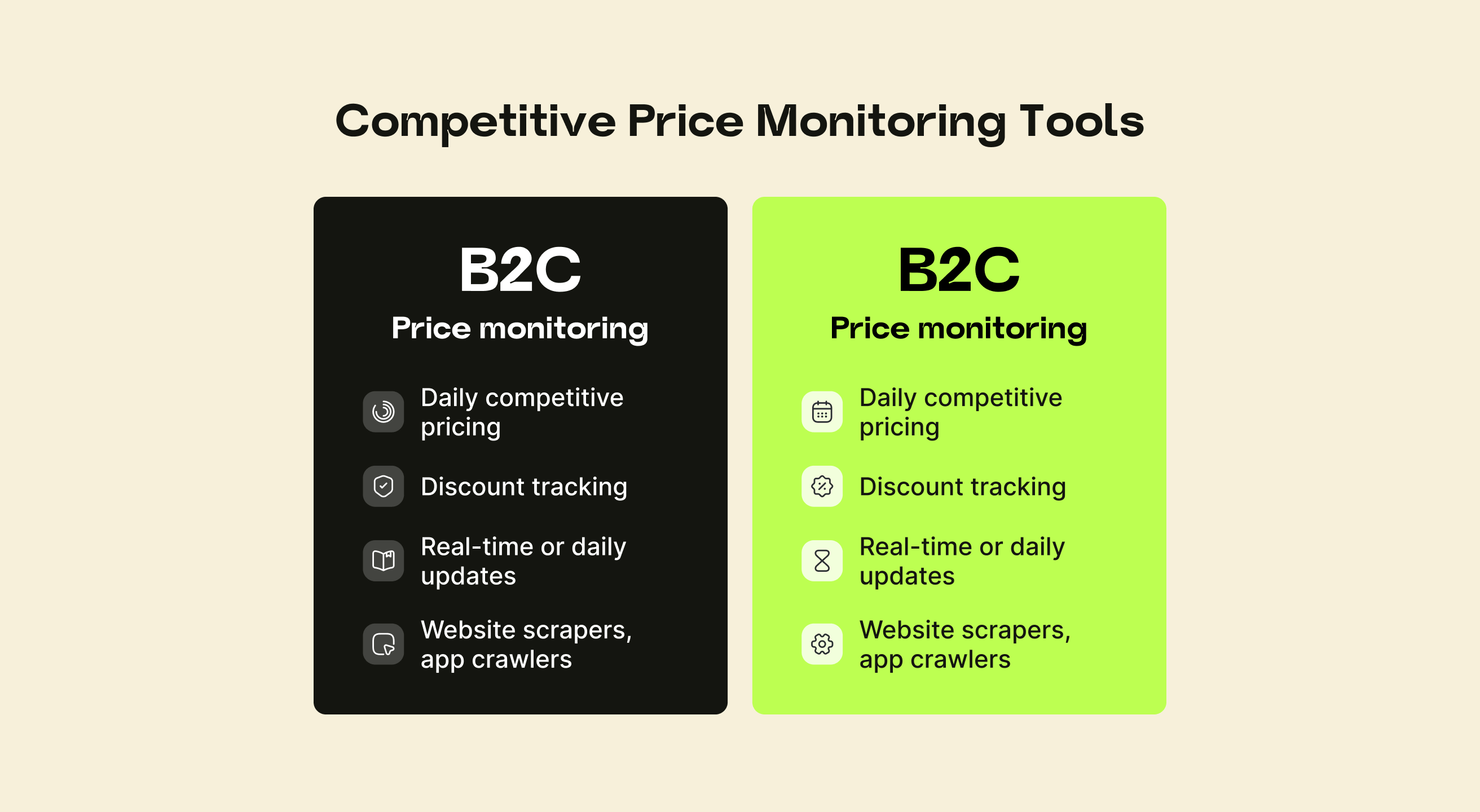
- Frequency: Real-time to daily updates capturing rapid market changes
- Sources: Website scraping, marketplace APIs, mobile app monitoring, comparison shopping engines
- Breadth: Hundreds to thousands of competitors across multiple channels
- Response: Immediate repricing capabilities to maintain competitiveness
Technology Stack:
- Automated web scraping platforms (ScrapeWise.ai, Bright Data)
- Real-time monitoring tools (Prisync, Omnia Retail)
- Dynamic repricing engines integrated with e-commerce platforms
- Alert systems triggering immediate team notification
Strategic Focus:
- Consumer price perception and psychological pricing thresholds
- Seasonal demand patterns and promotional calendars
- Category-level competitiveness maintaining position on key value items
- Conversion optimization balancing price and margin
Success Metrics:
- Price competitiveness index showing position versus market
- Sales lift following competitive price adjustments
- Margin protection while maintaining market share
- Speed of competitive response (hours vs. days)
B2B Competitive Price Monitoring
Market Characteristics:
- Longer pricing cycles with quarterly or annual negotiations
- Private pricing often hidden behind logins, portals, or PDF catalogs
- Volume-based discounts and contract-specific pricing
- Relationship-driven with pricing as one factor among many
Monitoring Requirements:
- Frequency: Weekly to monthly updates aligned with contract cycles
- Sources: PDF catalog extraction, portal scraping with authentication, distributor price lists, trade publication pricing
- Breadth: Focused competitor set (top 3-10 direct competitors)
- Response: Strategic repositioning rather than tactical repricing
Technology Stack:
- Specialized B2B tools (Skuuudle) handling catalogs and portals
- ERP-integrated trackers providing historical benchmarking
- Manual data entry workflows for relationship-based intelligence
- Competitive intelligence platforms combining pricing with market share data
Strategic Focus:
- Margin protection through cost-plus pricing discipline
- Volume discount structures competitive at key thresholds
- Contract renewal pricing informed by market benchmarks
- Customer lifetime value considerations outweighing single transaction pricing
Success Metrics:
- Win rates on competitive bids and RFPs
- Customer retention rates at contract renewals
- Gross margin maintenance across product lines
- Market share in key accounts and territories
Hybrid Approaches
Many businesses operate in both B2B and B2C channels, requiring integrated strategies:
- Separate monitoring cadences by channel (daily B2C, weekly B2B)
- Channel-specific pricing rules preventing conflict (typically B2B prices higher than B2C to protect distributor margins)
- Unified dashboards showing pricing position across all channels
- Governance ensuring pricing consistency where channels overlap
Monitoring MAP Violations with Automated Intelligence
Minimum Advertised Price (MAP) policies protect brand value and distributor margins, but manual enforcement becomes impossible at scale. According to 2026 market intelligence data, brands report that automated MAP monitoring has become essential for maintaining pricing integrity across reseller networks.
Why MAP Compliance Matters
MAP violations create multiple business problems:
- Brand erosion: Deep discounting devalues brand perception and premium positioning
- Channel conflict: Authorized resellers lose sales to violators, reducing their willingness to carry your products
- Margin pressure: Violators force price matching that compresses everyone's margins
- Market instability: Constant price variation confuses customers and reduces purchase confidence
How Automated MAP Monitoring Works
Modern platforms continuously scan both authorized and unauthorized distribution channels:
Detection Capabilities:
- Multi-channel coverage: Monitors authorized dealers, marketplaces (Amazon, eBay, Walmart), unauthorized resellers, and gray market sellers
- Real-time alerts: Immediate notification when listings drop below MAP thresholds
- Evidence collection: Automated screenshots with timestamps creating violation documentation
- Pattern recognition: Identifies repeat offenders and systematic violation trends
- Geographic tracking: Monitors regional pricing differences and cross-border violations
Enforcement Workflows:
- Automated notification to violating resellers with policy reminders
- Escalation protocols for repeat violations
- Integration with legal and brand protection teams
- Coordination with marketplaces for seller sanctions
- Detailed reporting for executive visibility and policy review
Best Practices for MAP Monitoring
Clear Policy Communication:
- Distribute written MAP policies to all authorized resellers
- Include MAP terms in dealer agreements with clear consequences
- Provide regular training on policy requirements and rationale
- Maintain public policy visibility creating market expectations
Strategic Enforcement:
- Prioritize highest-volume violators creating maximum market impact
- Focus on flagship products where brand perception matters most
- Document all violations consistently for legal defensibility
- Balance enforcement strictness with dealer relationship management
Technology Selection:
- Choose platforms with specific MAP compliance features (Price2Spy, Prowl, MetricsCart)
- Ensure coverage across your actual distribution channels
- Verify evidence collection meets legal requirements in your jurisdictions
- Integrate with existing dealer management and CRM systems
According to platforms like MetricsCart, advanced 2026 systems now provide predictive MAP compliance intelligence, identifying sellers likely to violate policies based on behavioral patterns and historical data.
Building a Complete Competitive Intelligence Stack
Comprehensive competitive intelligence extends beyond basic price tracking to encompass promotional activity, product assortment, market positioning, and trend analysis. Leading retailers build integrated stacks combining multiple tools and data sources.
Core Stack Components
1. Price Monitoring Foundation
- Primary tool: Enterprise platform (Omnia, Wiser) or mid-market solution (Prisync, ScrapeWise.ai)
- Coverage: All major competitors across all relevant channels
- Frequency: Aligned with market velocity (real-time for B2C, weekly for B2B)
- Output: Clean, matched pricing data feeding downstream systems
2. Product Matching Intelligence
- AI-powered algorithms identifying identical products across vendors
- Image recognition for visual product matching
- Manual validation workflows for edge cases
- Continuous learning improving match accuracy over time
3. Promotional Monitoring
- Banner and campaign tracking detecting competitor promotions
- Coupon code discovery identifying discount mechanics
- Sale cycle analysis revealing promotional calendars
- Discount depth measurement showing typical promotion levels
4. Analytics and Visualization
- Business intelligence dashboards (Tableau, Power BI, Looker)
- Real-time KPI tracking (competitive position, margin, conversion)
- Historical trend analysis identifying seasonal patterns
- Scenario modeling predicting price change impacts
5. Alert and Workflow Automation
- Threshold-based notifications triggering team action
- Tiered alert systems routing to appropriate decision-makers
- Automated ticket creation in project management tools
- Approval workflows for significant price changes
6. Integration Layer
- E-commerce platform connections (Shopify, Magento, custom)
- ERP systems (SAP, Oracle, NetSuite)
- Pricing engines and dynamic repricing tools
- CRM systems for customer-specific pricing
- Data warehouses consolidating all intelligence
Advanced Capabilities
Competitive Assortment Tracking:
- Monitor which products competitors carry and discontinue
- Identify new product introductions and category expansion
- Track stock availability and fulfillment options
- Analyze private label development
Review and Rating Intelligence:
- Scrape customer reviews across competitors
- Sentiment analysis revealing product perception
- Feature comparison from user feedback
- Quality signal integration with pricing decisions
Content and Feature Monitoring:
- Product description changes indicating positioning shifts
- Image updates revealing packaging or product changes
- Specification modifications improving or reducing offerings
- Marketing message evolution showing strategic pivots
Implementation Best Practices
Start Focused, Then Expand:
- Begin with core price monitoring on highest-revenue categories
- Prove ROI before expanding coverage
- Add promotional monitoring next, then assortment and reviews
- Build integration after manual processes prove value
Establish Governance:
- Define who can view competitive intelligence
- Set authorization levels for pricing decisions
- Create escalation procedures for major changes
- Document decision rationale for future review
Measure and Optimize:
- Track ROI metrics (margin improvement, sales lift, time savings)
- Conduct regular data quality audits
- Refine competitor lists quarterly
- Adjust monitoring frequency based on value delivered
Maintain Compliance:
- Respect robots.txt and rate limits
- Avoid scraping personal or authenticated data
- Document data sources for legal defensibility
- Stay current on evolving scraping regulations
According to 2026 market leaders, companies that combine price intelligence with broader competitive monitoring gain deeper strategic insights than those focused narrowly on pricing alone.
ROI of Automated Price Monitoring: Quantified Benefits
Investment in price monitoring technology delivers measurable returns across multiple business dimensions. Here's how leading retailers quantify value:
Direct Financial Returns
Margin Improvement: 3-20% Increase
- Prisync users report 3-20% profit margin gains depending on business size
- Reduction in underpricing by quickly matching market lows
- Elimination of overpricing that suppresses conversion
- Strategic pricing enabling premium positioning where justified
Calculation Example:
- Retailer revenue: $50M annually
- Current margin: 25% = $12.5M gross profit
- 10% margin improvement: $1.25M additional gross profit
- Tool cost: $50K annually
- Net ROI: $1.2M or 24:1 return
Sales Lift: 5-15% Revenue Growth
- Competitive pricing increases conversion rates
- Real-time matching captures price-sensitive shoppers
- Strategic positioning on key value items drives traffic
- Promotional timing optimization maximizes campaign impact
Calculation Example:
- Category revenue: $10M annually
- 8% sales lift from competitive pricing: $800K revenue increase
- Incremental margin (25%): $200K additional profit
- Implementation cost: $30K
- Net ROI: $170K or 5.6:1 return
Operational Efficiency Gains
Time Savings: 30-50% Reduction in Manual Work
- Elimination of manual price checking across competitor sites
- Automated report generation replacing spreadsheet compilation
- Self-service dashboards reducing ad-hoc analysis requests
- Alert systems eliminating reactive monitoring
Calculation Example:
- Pricing team: 3 analysts spending 20 hours/week on competitor research
- Automation saves 40%: 24 hours/week freed for strategic work
- Hourly cost fully loaded: $75/hour
- Annual savings: 24 hours × 50 weeks × $75 = $90K
- Tool cost: $40K
- Net savings: $50K annually plus higher-value strategic focus
Decision Speed: Hours vs. Days
- Real-time alerts enable immediate competitive response
- Automated repricing eliminates manual approval delays
- Reduced time from insight to action captures opportunities
- Faster problem detection prevents extended issues
Strategic Business Impact
Market Share Protection:
- Maintain competitiveness on price-sensitive products
- Defend against aggressive competitor pricing
- Capture share during competitor stock-outs
- Protect positioning against new market entrants
Customer Satisfaction:
- Consistent competitive pricing builds trust
- Availability when competitors stock out improves experience
- Appropriate value pricing reduces post-purchase regret
- Transparent positioning strengthens brand perception
Risk Mitigation:
- Early detection of competitive threats
- MAP violation identification protecting brand value
- Market intelligence revealing competitor strategy shifts
- Data-driven decisions reducing pricing mistakes
Calculating Your Specific ROI
Step 1: Baseline Current State
- Time spent on manual competitive research (hours/week)
- Frequency and magnitude of pricing errors
- Current gross margin by category
- Competitive position (% of time priced higher/lower than market)
Step 2: Estimate Improvements
- Conservative margin improvement: 3-5% for mature markets, 8-15% for dynamic markets
- Time savings: Typically 30-50% of manual research eliminated
- Error reduction: Elimination of significant underpricing or overpricing mistakes
- Strategic capacity: Hours freed for proactive strategy vs. reactive monitoring
Step 3: Calculate Financial Impact
- Margin improvement × revenue = Incremental profit
- Time savings × loaded cost = Labor cost reduction
- Error reduction × average error cost = Mistake avoidance
- Strategic capacity value = Opportunity cost of freed resources
Step 4: Compare to Total Cost
- Software licensing fees
- Implementation and integration costs
- Training and change management
- Ongoing maintenance and support
According to 2026 industry benchmarks, retailers typically achieve positive ROI within 3-6 months of implementation, with returns improving over time as usage matures and integrations deepen.
Conclusion: Competitive Price Monitoring as Strategic Infrastructure
Competitive price monitoring has evolved from tactical tool to strategic infrastructure. With the price monitoring software market growing at 13% CAGR toward $5.09 billion by 2033, driven by AI integration and competitive pressure, the question for retailers isn't whether to implement automated monitoring but how quickly to deploy systems that deliver measurable advantage.
The evidence is compelling: 90% of shoppers compare prices before purchase, 60% cite price as the key decision factor, and retailers using automated monitoring report 3-20% margin improvements alongside 30% time savings. These aren't marginal gains—they're competitive requirements in markets where price transparency and comparison happen instantly.
But technology alone doesn't deliver results. Success requires:
- Strategic tool selection matching your business model (B2B vs. B2C), scale (enterprise vs. mid-market), and geography
- Comprehensive intelligence stack integrating price monitoring with promotional tracking, assortment intelligence, and analytics
- Clear governance defining decision authority, response protocols, and escalation procedures
- Continuous optimization measuring ROI, refining competitor lists, and adjusting monitoring cadence
For teams serious about competing on price intelligence in 2026, platforms like ScrapeWise.ai provide purpose-built competitive monitoring infrastructure for e-commerce and wholesale operations. Combined with specialized tools for MAP compliance, dynamic repricing, and market analytics, retailers build systems that turn competitive intelligence from periodic research project into continuous strategic advantage.
The transformation from manual price checking to automated intelligence represents more than efficiency improvement—it's a fundamental shift in how retailers understand markets, position products, and compete. Organizations that embrace this shift position themselves to thrive as transparency increases and competition intensifies. Those that delay risk falling permanently behind competitors who move at the speed of automated intelligence.