
Introduction
Retailers and eCommerce brands are dealing with more data than ever — pricing, inventory, promotions, competitor insights, and more. But extracting and analyzing this data traditionally required developer support, complex ETL tools, and long lead times.
No-code automation tools are changing that.
With point-and-click interfaces and AI-enhanced workflows, anyone on your team — not just engineers — can set up automated data pipelines to fuel faster, smarter decision-making.
Let's explore how retail automation platforms and no-code data tools are revolutionizing competitive intelligence and why they're replacing traditional solutions.
Best No-Code Tools for Data Automation
What tools are retailers using to build data flows without code?
Here are some of the most effective no-code automation platforms for retail intelligence:
- Scrapewise – Built specifically for retailers and analysts, this platform automates competitive price tracking and product matching using no-code web scraping.
- Zapier / Make (Integromat) – Create automated workflows between tools (e.g., Shopify + Google Sheets + Slack) without coding.
- Parabola – Drag-and-drop data transformation flows to manipulate, merge, and clean retail data in real time.
- Airtable – Acts as a flexible database and dashboard, perfect for campaign tracking, inventory management, and marketing automation.
- Apify / Browse AI – No-code web scraping solutions designed for structured site monitoring and retail price intelligence.
These tools offer flexibility, speed, and scale — no developer tickets required. According to Gartner research, 75% of large enterprises will employ at least four low-code development tools by 2026, reflecting the mainstream adoption of no-code solutions across business functions. The global low-code/no-code development platform market is projected to grow from $37.39 billion in 2025 to $264.40 billion by 2032, with a CAGR of 32.2%.
How to Automate Web Scraping Without Coding
Modern retail data automation platforms make competitive intelligence frictionless.
Instead of hiring developers or using Python scripts, no-code scraping tools allow you to:
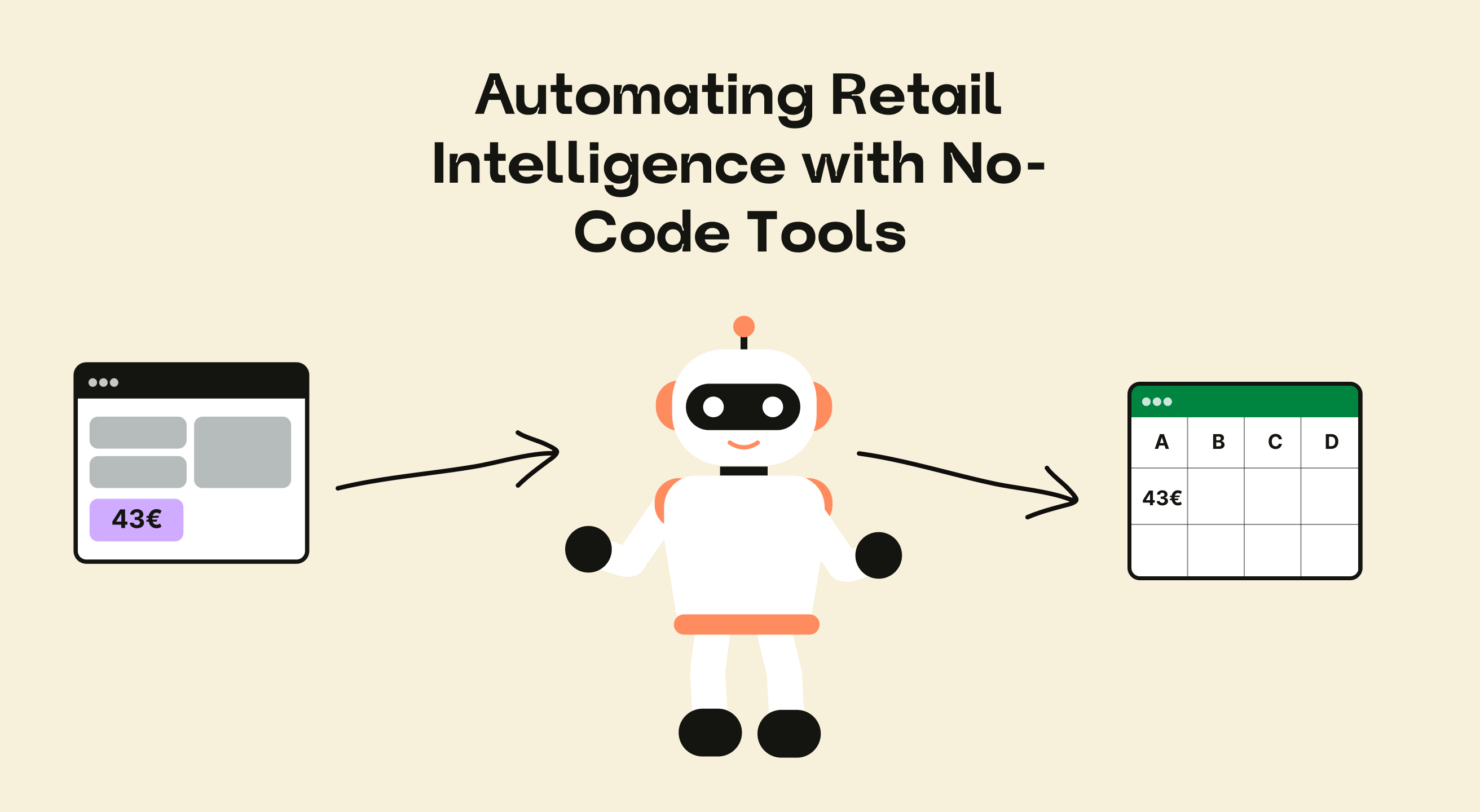
- Visually select page elements (like prices, images, descriptions, and stock levels)
- Schedule scrapes across multiple competitor sites or marketplaces automatically
- Export structured data to Excel, CSV, Google Sheets, or APIs for business intelligence
- Receive instant alerts when prices change or stock levels drop
This allows category managers, pricing analysts, and eCommerce teams to track competitive pricing and product availability without writing a single line of code. By 2026, developers outside formal IT departments will account for at least 80% of the user base for low-code development tools, demonstrating how citizen development is democratizing data access across organizations.
Empowering Data Teams with No-Code Workflows
No-code automation frees up engineering resources and empowers business teams with self-service data capabilities.
Here's what it unlocks for your retail or eCommerce organization:
- Self-service data access — Analysts and marketers can build custom dashboards and automated workflows without IT bottlenecks.
- Faster time to insight — Reduce development cycles from weeks to hours by eliminating dependency on engineering teams.
- Real-time competitive intelligence — Scheduled automation keeps pricing data, inventory levels, and promotional activity fresh and actionable.
- Cost savings — Organizations report an average of $187,000 annual savings using no-code solutions, with 6-12 month payback periods.
No-code platforms act as a bridge between business teams and data, reducing the friction between strategic ideas and operational execution. According to NRF 2026 insights, barcode scanners, RFID readers, and IoT sensors now work with AI to deliver real-time analytics and inventory accuracy—moving from simple data collection to actionable insights delivered through predictive alerts.
Real-Life Use Cases of No-Code Retail Tools
Real retailers are already using workflow automation and no-code data tools to drive measurable results:
- Price Monitoring: A Baltic eCommerce store uses Scrapewise to monitor 10 competitors across 3 countries, identifying margin gaps and repricing opportunities in real time—resulting in 12% margin improvement.
- Inventory Syncing: A furniture retailer uses Airtable + Parabola to sync inventory from suppliers to their Shopify storefront daily, reducing stockouts by 35%.
- Promotional Campaign Analysis: Marketing teams use Apify to scrape competitor banners, discount tags, and promotional messaging for competitive benchmarking and campaign optimization.
- E-commerce Order Automation: Over 2.2 million businesses use Zapier for automated workflows, with 38% leveraging automation to reduce data entry and streamline order fulfillment processes.
These examples show that you don't need software developers — just the right retail technology platforms and strategic implementation.
Scrapewise vs Traditional ETL: Built for Retail Intelligence
When comparing Scrapewise to traditional ETL (Extract, Transform, Load) tools, here's how they stack up for retail data automation:
Setup Time
- Scrapewise: Set up competitive price monitoring in minutes with a visual interface
- Traditional ETL: Takes days or weeks to configure data pipelines and transformations
Developer Requirement
- Scrapewise: No coding required — category managers and analysts can build workflows
- Traditional ETL: Requires data engineers or technical teams for implementation and maintenance
Maintenance & Adaptability
- Scrapewise: AI-powered adaptation automatically handles website structure changes and layout updates
- Traditional ETL: Breaks easily when competitor websites change, requiring manual code fixes and constant monitoring
Purpose-Built for Retail Intelligence
- Scrapewise: Designed specifically for retail use cases like competitive price matching, product monitoring, promotional alerts, and market intelligence
- Traditional ETL: Generic data integration tools needing custom scripting for retail-specific workflows
Scalability & Speed
- Scrapewise: Flexible and fast to adapt to new competitor sites, marketplaces, or data requirements
- Traditional ETL: Rigid architecture and slower to scale across multiple data sources
✅ If you're in retail, wholesale, or eCommerce operations, Scrapewise offers a much simpler and faster path to competitive intelligence — without the overhead of legacy systems or expensive data engineering teams.
The ROI of No-Code Retail Automation
According to 2026 no-code statistics, businesses leveraging low-code platforms report:
- 40% reduction in development costs compared to traditional software development
- 70% faster project delivery enabling rapid market response
- 90% of no-code users believe their companies grow faster because of these automation tools
- By 2026, 70% of new business applications will be built using no-code or low-code technologies
Retail technology spending is expected to reach $388 billion by 2026, with AI-related investments growing at nearly 25% annually—demonstrating the strategic priority retailers place on automation and data-driven decision-making.
Conclusion
Retail intelligence is no longer just for engineers or BI teams. With modern no-code automation platforms, any team can collect, process, and act on competitive data — from pricing and promotions to stock levels, product matching, and market trends.
The result? Faster decisions, leaner operations, better margins, and competitive advantages that compound over time.
If your retail team is still relying on manual spreadsheet updates, weekly price checks, or expensive developer resources, now's the time to explore platforms like Scrapewise and start automating your competitive edge. The retail automation market is moving toward $60.87 billion by 2032, and early adopters are already capturing the benefits of real-time intelligence and automated workflows.