
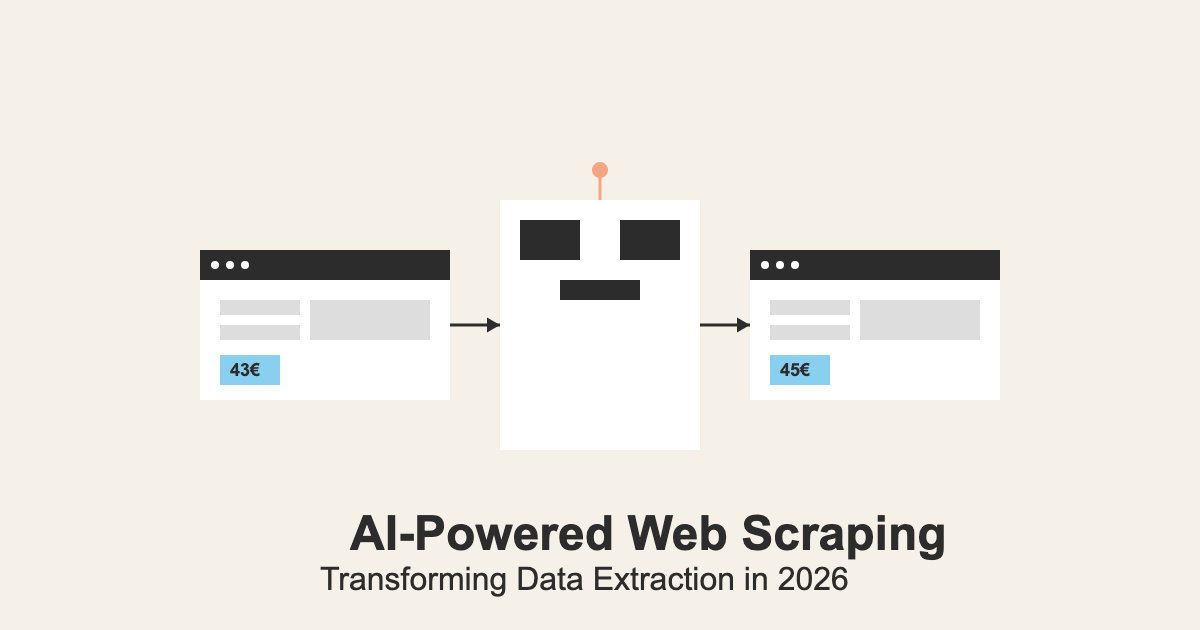
How AI-Powered Web Scraping Is Transforming Data Extraction in 2026
The web scraping landscape has shifted dramatically. Traditional scrapers that break with every website update are being replaced by intelligent systems that adapt, self-heal, and understand context like humans. This transformation isn't just about automation—it's about fundamentally changing how businesses collect and leverage web data.
With 72.7% of AI scraping users reporting improved productivity and the global web scraping market projected to reach $8.5 billion by 2032, AI-powered extraction has moved from experimental to essential. Yet 54.2% of professionals still rely on traditional methods, uncertain about making the leap.
This guide breaks down everything you need to know about AI web scraping in 2026—from how it actually works to which tools deliver results and why your competitors are already using it.
What Is AI-Powered Web Scraping?
AI-powered web scraping uses artificial intelligence to extract data from websites by understanding context and meaning rather than following rigid rules. Unlike traditional scrapers that rely on fixed HTML selectors, AI systems leverage machine learning, natural language processing, and computer vision to interpret webpage content the way humans do.
When you tell an AI scraper to "extract product prices," it understands that "$49.99" next to a "Buy Now" button is the price—regardless of whether the HTML class is labeled "price," "cost," or "amount." This semantic understanding enables scrapers to handle JavaScript-heavy pages, bypass CAPTCHA challenges, and continue functioning when websites redesign their layouts.
The technology emerged as a response to the most persistent problem in web scraping: maintenance. Traditional scrapers spend 20% of development time building and 80% maintaining. AI flips that ratio, reducing maintenance to nearly zero through autonomous adaptation.
Why AI Web Scraping Matters for E-Commerce and Pricing Intelligence
For e-commerce managers and pricing strategists, AI-powered scraping solves three critical business challenges that traditional methods can't address effectively.
Real-Time Competitive Intelligence
Markets move faster than humans can track. AI scrapers monitor competitor pricing, product availability, and promotional strategies across hundreds of sources continuously. When a competitor drops prices or launches a new product, decision-makers know within minutes instead of discovering it days later through manual checks or broken scraping pipelines.
A multi-category online retailer using AI-driven extraction improved demand-forecasting accuracy by 23%, cut stock-outs by 35% (saving approximately $1.1 million annually), and freed $900,000 in working capital by optimizing inventory based on real-time competitive data.
Zero-Maintenance Data Pipelines
Website redesigns used to mean emergency calls at 2 AM and scrambling developers to fix broken selectors. AI-powered systems detect layout changes automatically and repair themselves without human intervention. According to research from McGill University testing 3,000 pages across Amazon, Cars.com, and Upwork, AI methods maintained 98.4% accuracy even when page structures changed completely.
This translates directly to cost savings. Engineering teams shift from firefighting scraper failures to building strategic analysis tools. The infrastructure that once required constant oversight now runs reliably in the background.
Democratized Data Access
Traditional web scraping required specialized engineering knowledge. AI tools with natural language interfaces and no-code platforms enable marketing teams, pricing analysts, and operations managers to extract data independently. Platforms like ScrapeWise.ai, Browse AI, and Octoparse allow non-technical users to describe what data they need in plain English, removing the bottleneck of IT dependencies.
This matters particularly for mid-market companies that lack dedicated data engineering teams but compete against enterprises with sophisticated market intelligence operations.
How AI-Powered Web Scraping Actually Works
AI web scraping combines three core technologies that work together to create adaptive, intelligent extraction systems.
Machine Learning for Pattern Recognition
Machine learning models analyze webpage structures to identify data patterns without manual configuration. When trained on examples, these models learn to recognize product titles, prices, ratings, and descriptions based on visual positioning, surrounding context, and semantic meaning rather than specific HTML tags.
Convolutional neural networks (CNNs) can identify visual elements like buttons, images, and form fields the same way they recognize objects in photographs. This approach works even when the underlying code changes because the visual relationships between elements remain consistent.
Natural Language Processing for Context Understanding
NLP enables scrapers to interpret text content and understand relationships between data points. When extracting product information, NLP helps distinguish between the actual price, the original price, the shipping cost, and promotional text—even when they're formatted similarly.
For sentiment analysis and review extraction, NLP processes customer feedback to categorize opinions, identify key themes, and extract actionable insights automatically. This is particularly valuable for competitive intelligence when analyzing thousands of product reviews to understand market perception.
Computer Vision for Layout Interpretation
Vision-language models (VLMs) take visual snapshots of web pages and identify elements based on what they "see" rather than reading HTML code. Tools like Firecrawl and Crawl4AI pioneered this "zero-shot" extraction approach in 2026, where the AI identifies the shopping cart icon, recognizes price placement near product images, and understands navigation structure through visual patterns.
This matters because visual relationships persist across redesigns even when code structure changes completely. A price will still appear near the product image whether it's in a div, span, or custom web component.
Self-Healing Automation
The breakthrough feature of modern AI scrapers is autonomous maintenance. These systems continuously monitor extraction accuracy and automatically regenerate code when websites change. Instead of running AI models on every single page extraction (which would be prohibitively expensive), efficient platforms use AI to generate traditional scraper code once, then deploy monitoring agents that trigger code regeneration only when failures occur.
According to Apify's 2026 State of Web Scraping Report, 63.6% of AI scraping users employ AI for code generation while 32.7% use it for data extraction and parsing, with 72.7% reporting productivity improvements from faster prototyping and reduced manual effort.
Common Challenges in Web Scraping and How AI Solves Them
Challenge 1: Website Anti-Bot Protections
Modern websites deploy sophisticated detection systems from Cloudflare, Akamai, and Datadome that analyze browser fingerprints, mouse movements, and request patterns to identify automated traffic. Traditional scrapers get blocked frequently, requiring constant proxy rotation and configuration updates.
AI Solution: AI-powered tools simulate human-like behavior with realistic mouse paths, varied timing patterns, and natural browsing sequences. They learn from successful extractions to refine their approach continuously. Platforms with built-in proxy management and CAPTCHA solving handle these challenges automatically without manual intervention.
Challenge 2: Dynamic JavaScript-Heavy Sites
Single-page applications and dynamic content loading make traditional scrapers unreliable. Content that appears only after JavaScript execution or user interactions requires browser automation, which is slow and resource-intensive.
AI Solution: AI scrapers determine the most efficient extraction method automatically—whether that's direct API calls, JavaScript rendering, or targeted DOM interaction. They identify which elements require browser execution and which can be extracted directly, optimizing for speed while maintaining accuracy.
Challenge 3: Inconsistent Data Structures
E-commerce sites often present information differently across product categories. One page might list specifications in a table while another uses bullet points. Handling these variations requires extensive custom logic in traditional scrapers.
AI Solution: Semantic understanding enables AI extractors to recognize that "Product Dimensions," "Size," and "Measurements" all refer to the same type of information regardless of formatting. The system adapts to structural variations automatically rather than requiring separate scrapers for each page layout.
Challenge 4: Data Quality and Validation
Scraped data often contains inconsistencies, duplicates, and errors that require manual cleanup. Traditional pipelines lack built-in quality controls, leading to unreliable datasets that undermine business decisions.
AI Solution: Modern AI platforms include automated data validation with schema enforcement, confidence scoring, and completeness tracking. According to HubSpot's 2026 Marketing Trends Report, 67% of marketers now use automation for data collection, with quality validation being a key driver of adoption. Tools can flag anomalies, detect missing fields, and even infer missing data points based on context.
Challenge 5: Scale and Cost Management
Scraping thousands of pages requires infrastructure management, proxy costs, and computing resources. Traditional approaches struggle with cost efficiency at scale, especially when dealing with anti-bot systems that increase failure rates.
AI Solution: Cloud-based AI scraping platforms optimize resource allocation automatically. They determine optimal request timing, select appropriate proxy types, and parallelize tasks efficiently. The shift from running AI models on every request to using AI for code generation and maintenance dramatically reduces per-page costs while maintaining adaptability.
Advanced Strategies for AI Web Scraping Implementation
Strategy 1: Start with High-Value, High-Change Data Sources
Don't attempt to migrate every scraping task to AI immediately. Focus first on data sources that change frequently and have significant business impact—competitor pricing pages, product availability, promotional campaigns. These deliver immediate ROI through reduced maintenance and faster insights.
Platforms like ScrapeWise.ai specialize in competitive intelligence automation, making them ideal for pricing strategy teams that need reliable, real-time market data without engineering overhead.
Strategy 2: Combine AI with Traditional Methods
The most effective implementations use AI for adaptability and traditional code for execution speed. Generate scraping logic with AI tools, then deploy it as optimized code that runs efficiently at scale. Use AI monitoring to detect when regeneration is needed rather than processing every request through language models.
This hybrid approach, recommended by Backlinko's data infrastructure experts, delivers both the flexibility of AI and the performance of traditional scrapers.
Strategy 3: Implement Continuous Quality Monitoring
Set up automated quality checks that validate data against expected schemas, track completeness metrics, and flag anomalies. AI systems should include confidence scoring for each extracted field, allowing you to identify and investigate low-confidence results before they impact business decisions.
Tools that integrate with data warehouses and BI platforms enable immediate validation against historical patterns and business rules.
Strategy 4: Respect Rate Limits and Implement Ethical Scraping
AI tools make it easier to scrape at scale, but that doesn't mean you should maximize speed indiscriminately. Configure rate limits that respect target websites' resources, honor robots.txt directives, and implement polite scraping practices.
According to Moz's Technical SEO Best Practices, ethical scraping not only prevents legal issues but also reduces the likelihood of being blocked, improving long-term data collection reliability.
Strategy 5: Build for Compliance from Day One
With data privacy regulations tightening globally, ensure your scraping operations comply with GDPR, CCPA, and industry-specific regulations. Document what data you collect, why you need it, and how you use it. Avoid collecting personal information unless absolutely necessary and legally justified.
SEMrush's compliance framework guide provides detailed requirements for businesses operating in multiple jurisdictions.
Top AI Web Scraping Tools and Platforms for 2026
For Non-Technical Users: No-Code Platforms
Browse AI offers visual "robot training" where users click on elements they want to extract. With over 770,000 users, it provides prebuilt robots for common sites and custom options for unique needs. Pricing starts at $49/month with a free tier available.
Octoparse features AI-assisted field detection and workflow suggestions with preset templates for popular websites. It handles IP rotation, CAPTCHA solving, and infinite scrolling automatically. Ideal for marketing and operations teams needing quick setup without engineering support.
For Developers: API-First Solutions
ScrapeWise.ai provides managed web scraping infrastructure specifically designed for e-commerce and competitive intelligence. The platform handles proxy management, anti-bot evasion, and data quality validation, delivering structured data through simple API calls.
ScrapingBee offers an AI-powered API that requires no coding for rendering, parsing, and extraction. It automatically handles JavaScript execution and returns structured data, making it the easiest integration for development teams.
Oxylabs leads in enterprise-grade extraction with AI-integrated scraping APIs that auto-parse layouts and adapt to structural changes using machine learning. With 175 million IPs across 195 countries, it's built for large-scale operations requiring high success rates against sophisticated anti-bot systems.
For Custom Development: AI-Powered Frameworks
Crawl4AI and Firecrawl offer zero-shot extraction using vision-language models. Purpose-built for developers feeding scraped data into LLM pipelines (RAG, fine-tuning), these tools output clean Markdown ideal for AI applications.
Kadoa provides autonomous scraping infrastructure where AI agents generate and continuously maintain deterministic scraping code. The platform includes source grounding, confidence scoring, and comprehensive compliance audit logs for enterprise deployments.
According to Neil Patel's automation strategy research, companies using managed scraping platforms report 3-5x faster time-to-value compared to building custom solutions.
Conclusion: The Future of Data Collection Is Adaptive
AI-powered web scraping represents a fundamental shift from maintenance-heavy scripts to adaptive intelligence systems. As websites become more dynamic and anti-bot protections more sophisticated, AI's ability to understand context, self-heal, and operate at scale becomes not just advantageous but necessary.
The 54.2% of professionals still using traditional methods aren't wrong to be cautious—adoption requires understanding which use cases justify the investment. Start with high-value, frequently changing data sources where maintenance pain is highest and business impact is clearest.
For teams serious about competitive intelligence and market monitoring, platforms like ScrapeWise.ai remove the complexity of building and maintaining scraping infrastructure, letting you focus on analysis and strategy rather than firefighting broken scrapers.
The question in 2026 isn't whether to adopt AI-powered scraping, but how quickly you can implement it before your competitors gain an insurmountable data advantage.